
A lot of times, I get asked about how to solve some problem. Sometimes it is a small issue that can be solved with using a script or a mapping.
There are lots of limits to free consulting.
Other times, there is a much more detailed architectural discussion about how to solve a larger problem with clients. Then it becomes much more interesting.
Do you just implement the solution or do you wait until you have found someone that can handle the architectural process?
In a recent discussion, we had the following case. The user wanted to expose master data to the organization. It was pretty easy to create an OData service and then expose it via SAP API management. This will give all the required functions for exposing the data. And it will probably take less than 20 days to solve.
It would be nice to have an ISA-M document that showed how they did integration in the organization. Then we could easily start the project. Now we would need to find some architect that understands the process and start an ISA-M or something similar.
I had a survey wondering if you wanted to just solve the problem or wait till the architecture is in place. 1/3 of respondents said just go ahead and implement.
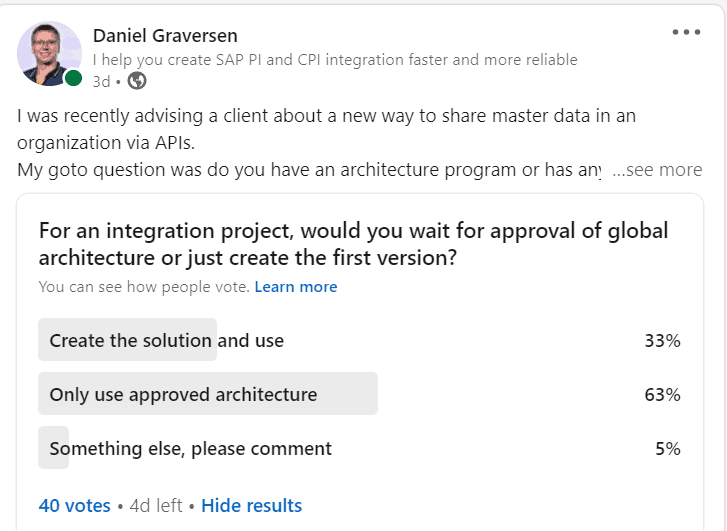
And as always, it depends on the client and the project what they are up to and what will work.
I do think that working with such a project will give the organization a number of learnings that will be useful when working on the full architecture. Then you may need to change the process as you go.
As always it really depends on the project and the number of stars on the shoulders of the people that own the integration if they can turn it into a useful service for the organization. A lot of times I see just a business owner that has a problem and wants to solve it via integration. As an outsider, my job is more to solve those problems and then give the advice I can.
One challenge with just implementing the process is that you may develop some silo that only a few people care about and that will not get maintained. This is probably true in a lot of cases for API-led integrations. Will they be used? And how will you ensure that users will know they can use the application?
It will be interesting to see if the project turns into a reality or it is sacrificed on the altar of architectural governance?