
I often get the question why to spend money on Figaf’s PI to Integration Suite migration tool, compared to using SAP’s free tool. Is there a business reason?
If SAP’s tool works well for you, even with the need for manual work, then use it.
But if you find yourself having to spend hours on making an iFlow work. Then it would be worth considering exploring Figaf. Hopefully you will see that it creates a better result. We do have free options to try it out.
SAP has made big progress in the migration since the first version but we still hear from customers they need to make manual changes. And all mentions here may change later.
ChatGPT 5 summary of the differences.

There is much more to migration than just technical migration. Figaf can do the migration, record the test case and run the test case on the migrated iFlow from a single screen with a few clicks. This will boost the developers’ productivity and reduce the dependencies on business people in Migration project and shorten the timeline.
UDF and function libraries
One of the big changes is that Figaf converts UDF from mappings and Function Libraries into Groovy scripts. This gives the best option for building new functionality and if you combine it with the Groovy editor then it becomes easy to support.
If there are lookups or use of an unsupported API then the UDF code is commented and you can then find a solution for it.
You can also use SAP’s FL object and even mix some functions for using one vs the other. The FL object does support usage of All values of a queue.
But the more options you have the better.
Message mappings
The big part of a migration is the message mappings and how well you can migrate them. Figaf uses its own logic, which means we can support mapping of parameters and configure them. It means we can make custom changes to the logic of the migration if there are special requirements.
There is special conversion for some of the problems in the migration.
Figaf uses local message mappings and works with the WSDL/XSD. This makes it easier to manage the integration.
Channel mappings
In Figaf you can create your custom templates for migrating channels. Just take an existing iFlow where you have configured the adapter correctly and externalize the values that you want. Then use it as a template.
The template is XSLT so it is easy to add looks in the file channel. And you do have a full IDE to build the XSLT and make sure it works. This simplifies the migration.
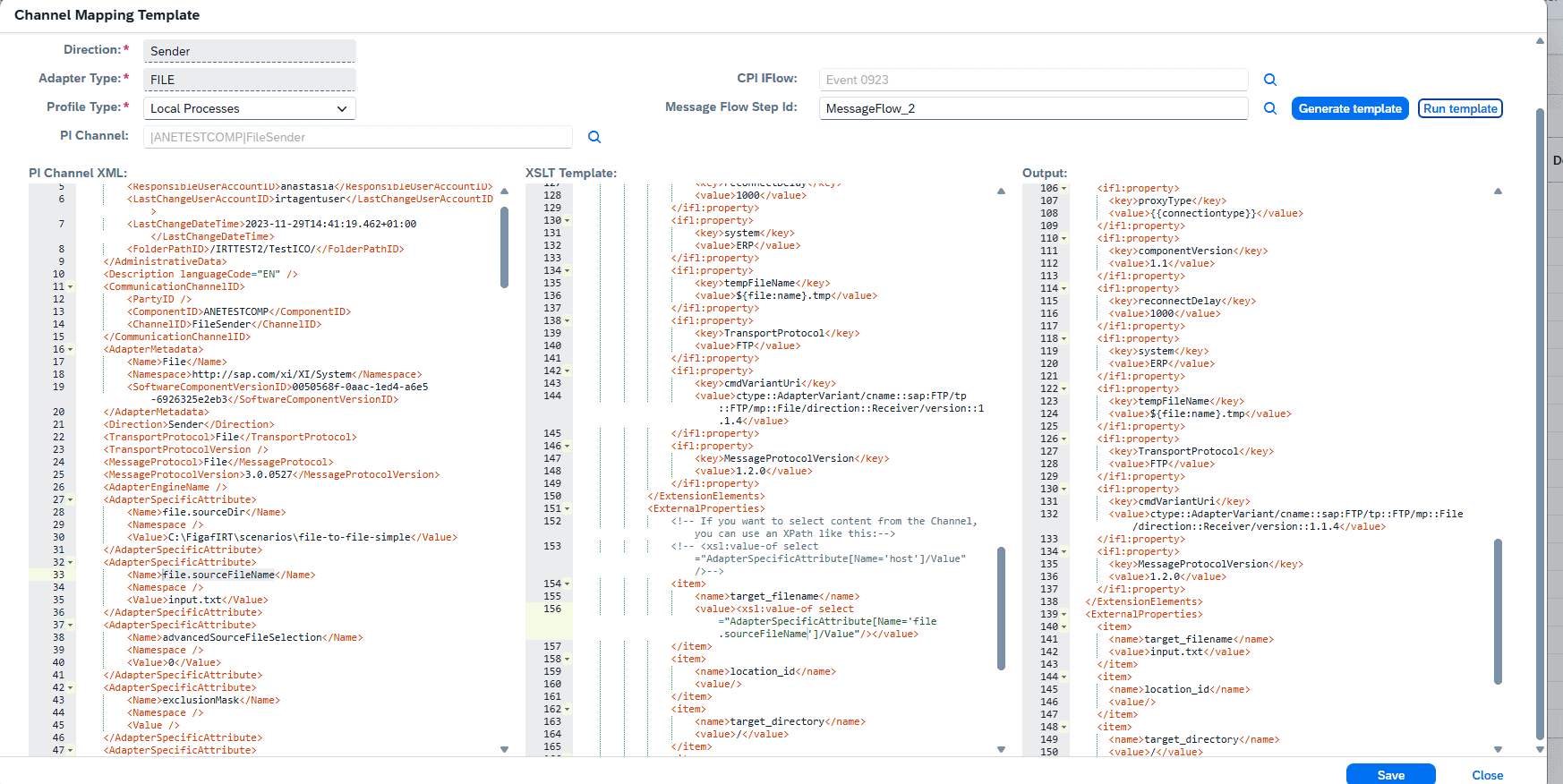
And if you are migrating from SAP PI production the tool supports changing the host name to development in the global configuration.
External parameters
Because of the customization of templates, it means that you have much fewer externalized parameters. Figaf only gives you the ones that make sense to convert and have been customized for your use case.
The fewer parameters you have the easier it becomes to configure the iFlow when moving in your landscape.
And remember with Figaf transport you can automate replacement of SAP dev hostnames with SAP prod allowing much fewer manual changes to happen.
Flow
The flows differ significantly. It is a preference based decision what you prefer. Since September 2024 SAP has been generating iFlow based on ICO content and not templates anymore.
There are still differences in the flows generated and I think we have some more reliable flows that supports your own migration.
With Figaf you also have the option to use your existing template flows and then plug in your Operation Mappings into separate local processes. This will make it possible for you to have the flows that you want for the integration.
B2B: TPM migrations
In the B2B space, Figaf has been improving the process to create fully functioning B2B scenarios. This allows you to quickly migrate all your integrations from the Operation mappings and plug it into a TPM agreement so you can start testing it. This is a clear place where the Figaf tool helps.
There are still limitations if you are using some of the UDF for using the TPM lookups that would need to be rewritten, unless you use it at header value where the standard TPM settings can replace it. Figaf also has a way to convert between SAP B2B and IS MIG structure in a single groovy script.
In Figaf you can easily migrate an Operation mapping and connect it with the TPM flows you have. This will reduce the effort for migration and create consistent flows. This will allow you to migrate later to MAGs, if it makes sense.
Java mappings
We use the same approach for it, which is not ideal. We move the Groovy script to call a jar of the original java mapping. There are some limitations like using Dynamic Attributes etc which mean probably 50% of mappings will not work because of this. But realistically you should convert it into a Groovy script for better supportability (Figaf’s Groovy Editor helps you here).
ABAP and (cc)BPM
Neither SAP nor Figaf supports migrating this. It will require you to build something new. You can use the message mappings used in the flows.
Speed of change
One aspect where it is possible to see a difference is how long it takes to make improvements. Figaf had full pipeline support in May 2024. SAP had it after around 10 months.
This enables Figaf to build more small features based on customer requirements. This is the part that allows you to complete a migration project or not.
Message types
SAP uses Message Types and Data Types, which add extra objects that need to be maintained. There are cases where it will make sense.
Edge cases
The challenge with any migration tool is how the edge cases are supported, like how to convert JDBC, or File Content converter. In Figaf we have been able to add a fully functioning File Content Converter that is configured.
You can also add mappings for Adapter Modules to Groovy scripts.
Configurations
In Figaf you can customize a lot of parameters of your migration so it matches your requirements for the landscape.
End-to-end flow
Figaf supports the full journey from clicking migration to running the tests and finally move to production.
Why not give it a try
You can get access to the Figaf tool using our free migration edition. This is the one recommended by SAP to help you test the migration. You should have a strategy for testing your migrated content.
With the tool, you get 10 free migrations. Do your own comparison to see if it brings value to your project.
If you can just save 1 hour on a migration it would be well worth the cost. And it can be a mixture you will need to be using but it is better to have more options than end up with some iFlows that will not be migrated and would need to be redesigned.