
SAP TechEd turned 30 this year, and almost every keynote slide had an agent on it. For those of us who work with SAP Integration Suite, the most interesting announcement under all that is the SAP Enterprise AI Gateway.
It is not flashy. It is a governance layer, and that is exactly why it is worth looking at. This post covers what it is, what it builds on, and who I think it is for.

What it is
SAP positions the Enterprise AI Gateway as one control point for the traffic that agents create. It covers four kinds of traffic without forcing everything into one protocol:
- APIs: the conventional calls you already manage.
- MCP: agents calling tools and data (Model Context Protocol).
- A2A: agents talking to other agents (Agent2Agent).
- Models: calls to LLMs.
It is built on SAP Integration Suite. The MCP Gateway part is already live in Integration Suite, and this is the extension for the other protocols.
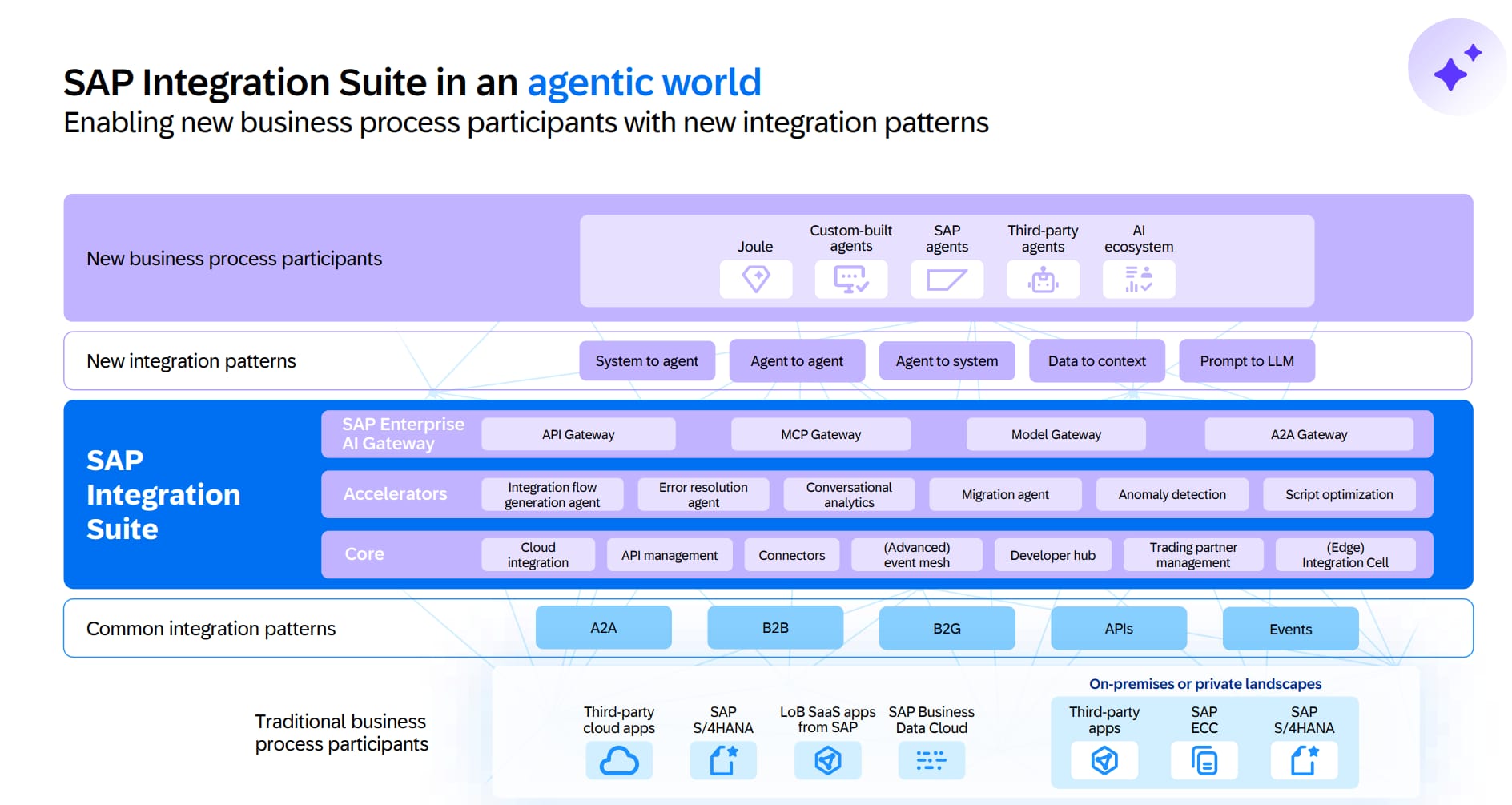
It looks nice, and it is the right idea: agents become a heavy new consumer of integration, and they need the same contracts, authentication and monitoring as everything else. Whether it holds up in practice is a different question. Let’s see how it behaves.
Tricentis testing tool
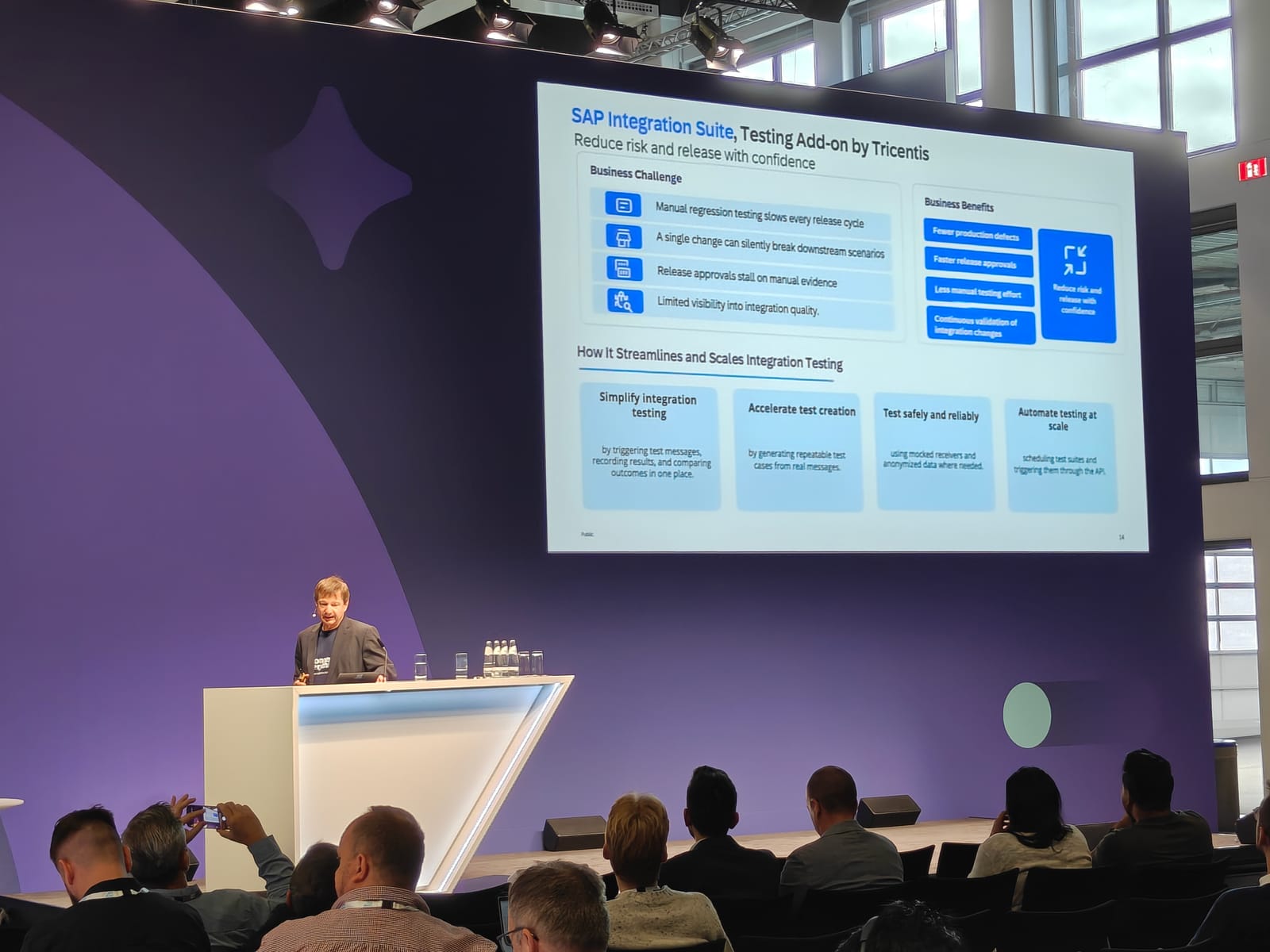
SAP announced a testing partnership with Tricentis. Automated testing for Integration Suite is something the community has asked about for years, so it is good to see SAP take it seriously and bring in a well-known testing vendor.
I looked at the functionality that was shown, and it looks a lot like what Figaf offers. That is not a surprise: it is the same problem, and a proper answer to it needs test cases that run against real integration flows, and a way to compare results before and after a change. It also confirms that testing is a core part of working with Integration Suite, especially around migration and change.
AI everywhere, but hard to explore
Outside the gateway, there was AI sprinkled across a lot of Integration Suite features. From a product perspective that is probably good, but it is hard to explore from the outside.
Two observations:
- The new functionality seems to sit in the enhanced edition. That looks like a push for customers to upgrade, since that is where the new AI features land.
- Partners need a way in. Many of these features can only be judged by trying them. I hope SAP offers partners access so we can explore what they do and report back honestly.
TechEd as a roadmap source
The roadmap was full of AI and new adapters. Roadmap details are also available online and updated continuously, so for me a big part of the value of TechEd is the conversations with customers, consultants and SAP product people.
More migration tools
I talked with four consultancies that have developed their own migration tools, and there are certainly more out there. This is mainly because SAP’s standard tool does not cover all migration scenarios.
Developing migration tools is also much easier today than it was four years ago. However, there is an important difference: consultancies typically develop their tools for internal use on their own projects, whereas our tool is available for anyone to use. Both customers and partners can purchase direct access and use it independently.
I would therefore consider our tool if you encounter too many challenges or limitations with SAP’s standard migration tool. It gives you an alternative that you can access and use directly, rather than relying solely on the standard solution.
The most important part: the people
For me, the most important thing about TechEd was the chance to meet partners, customers and prospects in one place, and to hear what they are doing, why they are doing it, and what they think about integration and Integration Suite.
You do not get that from a keynote or a roadmap slide. I came home with a clearer picture of how customers approach migration, where consultancies are building their own tooling, what governance questions people are starting to ask about agents, and where Integration Suite still frustrates people. That is what shapes what we build and write about next.
Customer and community presentations
I attended four customer presentations and one from the community. They were more useful than many of the announcements, because they showed real landscapes and real trade-offs.
1. Versuni: testing the EDI landscape with Int4. They presented a product that tested P2P scenarios end to end, and made the point that you cannot handle a big migration project without a testing tool. I would agree that you need to have your test cases and that it needs to be technical, but I would probably recommend Figaf for testing.
2. TÜV Rheinland: tips for integration. They told how they had used Figaf for their migration, and showed several scenarios where they automated their landscape.
3. Algoma Steel: PI/PO to B2B. A steel company presented their move from PI/PO to B2B on Integration Suite. They built up a full B2B setup and showed what that makes possible. While doing it they gave feedback to SAP product management, and SAP added some of the improvements they asked for. So B2B on Integration Suite is still moving, and customers drive it. It makes sense for some, not for everybody: it pays off with many partners and document types, less with a handful of simple connections.
4. AkzoNobel: migration at scale. Rojo described a migration of about 3,500 interfaces that ended up spanning several platforms and scenarios. At that size the work is less about converting one interface and more about sorting, sequencing and testing very different cases.
5. Vadim Klimov: MCP for APIs is not enough on its own. Vadim Klimov, a well-known name in the SAP integration community, gave a good presentation about AI tooling. The point that stuck with me is that an MCP server in front of your APIs is a good start, but probably not enough. An agent that only calls APIs sees the operations, not the content around them: documentation, configuration, how interfaces relate to each other. To use that, you most likely need RAG or a knowledge graph on top, so the agent can look into more content than the API exposes.
Smaller TechEd notes
- 16,000 customers on Integration Suite (13,000 at TechEd 2024).
- The MCP server in Integration Suite now supports proxying existing MCP servers.
- It seemed like there were more consultants than customers. We are all looking for new customers, so I hope more join next time.
Next TechEd: 2–4 November 2027, Barcelona.