
How much will your SAP PI/PO migration really cost?
We have built three free tools. The first one gives you a quick answer, and the other two help you plan the whole project.
Figaf B2B Management
SAP Trading Partner Management gives you the standard. Figaf adds the operating model around it: guided onboarding, reusable agreement templates, validation rules, and regression tests that cover every partner rather than the last one you touched.
If your team can’t answer these questions straight away, don’t worry. Figaf B2B Management can make the answers clear and accessible.
Nine quick questions about your SAP PI/PO B2B landscape. We plot your go-live on a real calendar, weekends and public holidays included, then show you how much sooner you get there with Figaf.
It takes about 2 minutes. Nothing leaves your browser.
To help you understand where Figaf can help in your B2B migration, we have created a workshop where we go through your installation. In this two-day workshop, Figaf’s B2B expert Emil Jessen shows you how to reuse what you have, and helps you decide where a rebuild actually pays off.
Migrating your B2B interfaces from SAP PI/PO to SAP Integration Suite doesn’t have to be a painful, manual process. The demo shows Figaf as a migration accelerator: partner provisioning, migration of operation mappings, and regression testing.
Everything in Figaf B2B Management is built around standard SAP objects: partners, agreements and templates. We don’t replace Trading Partner Management. We add the naming conventions, validation rules and change control it leaves open, so the spreadsheet your team maintains today becomes a rule the platform enforces.
The guided setup automates scoping, templates and validation, so onboarding a partner is faster and no longer depends on which specialist happens to remember the convention. That means fewer human errors, not just more productivity.
Scalability. The hundredth partner should take no more effort than the tenth.
Robustness. The setup should behave the same regardless of who built it, which environment it is in, or what changes around it.
We only enhance SAP standard. We never replace it.
Every customer running Figaf still has 100% SAP standard TPM underneath. You can use Figaf, scale it back, or remove it completely, at any point, without losing that standard functionality. You’re not locking yourself in. If a better solution comes along, whether that’s SAP’s own roadmap or something you build yourselves, walking away from Figaf stays simple.
Everything below writes into standard SAP objects: standard partners, standard agreements, standard templates. Open a feature to see how it works and what it looks like in a real landscape.
Create the partner, pick or generate the agreement template, and build the agreement step by step. Each step shows what is being set and why, so nothing is inherited from a default no one noticed.
In practice: A new team member onboards their first partner in an afternoon, without the B2B lead sitting next to them. Read more →
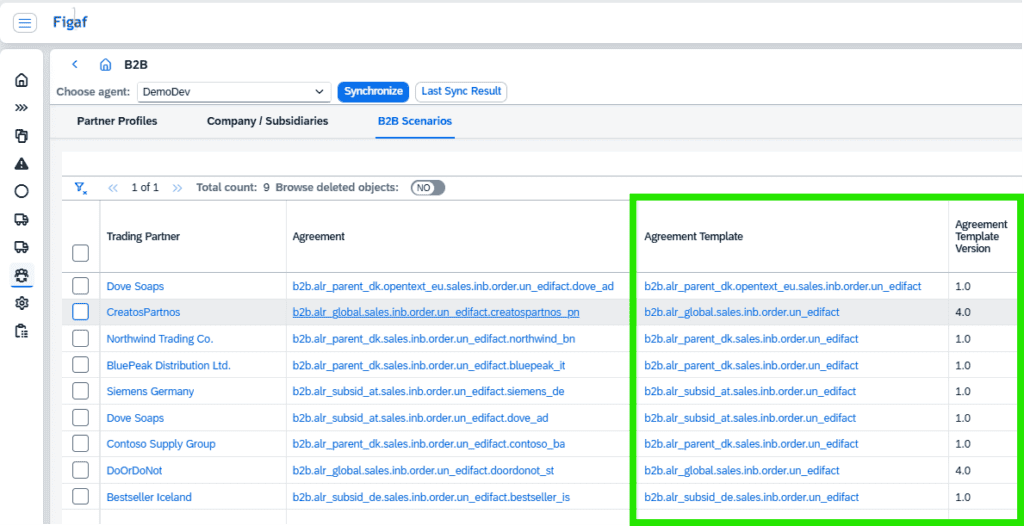
Define the pattern once, then generate every agreement from it instead of hand-building the same fields for every partner. Deviations from the template are visible, not buried in a one-off configuration.
In practice: A new EDIFACT partner inherits the template your other forty EDIFACT partners already use, instead of being configured from scratch. Read more →
A rules engine checks naming conventions, identifier schemes, and MIG and MAG version consistency against production, and flags what is off standard before it becomes someone else’s problem.
Existing partner data, message mappings and test messages carry over into the new TPM structure, so moving to Integration Suite is a gradual transition rather than a rebuild from scratch.
In practice: Medela migrated its first 13 trading partners to Integration Suite with Figaf, moving existing B2B mappings to the TPM structure in a common way with one B2B mapping per day, and no defects were reported by the partners moved live.
Partners, agreement templates and agreements move between environments as a tracked, versioned unit, with the linked iFlows, and production import is blocked automatically while anything is unclean.
In practice: In Medela’s migration, manual TPM transports were the bottleneck. Figaf added automation for creating trading partner profiles and agreements, and for transporting the agreements.
Record a real message, replay it against the agreement, and compare the output, so every agreement has a test case tied to it instead of relying on a one-time manual check.
In practice: Onboarding partner 340 without manually re-verifying the 339 already live. Read more →
See interchanges, groups and transactions in one view, with payloads archived and searchable, so you can answer what happened without digging through raw logs.
In practice: Three messages from this partner failed this morning, rather than iFlow_EDI_0042 threw an exception. Read more →
Every validation run produces a report ranking issues by severity, so your team fixes what is actually urgent first instead of triaging blind.
Before you start moving partners, make sure you know what to reuse, what to automate and how to build a setup that can scale.
30 minutes with someone who has done this before.

We have built three free tools. The first one gives you a quick answer, and the other two help you plan the whole project.
Two first FAID apps, and a preview of how Figaf will help you run SAP standard B2B; step-by-step, app-by-app, agent-by-agent.
Ten points to settle before a B2B migration to SAP Integration Suite: inventory, MAGs or mappings, testing, governance, transports, partners and automation.