Every trading-partner agreement is slightly different, for no good reason.
Drift between partner agreements is not a configuration problem, it is a maintenance problem. Forty partners configured forty slightly different ways means forty things to check whenever something changes. Figaf B2B Management lets B2B teams define the approved pattern once as an agreement template in SAP Trading Partner Management (TPM) and generate agreements from it, so the common case is identical and the genuinely different partners are the only ones that need thought.
How it works
Standard SAP objects. Templates are standard TPM agreement templates. Figaf adds the structure around them and writes into standard partners, agreements and templates.
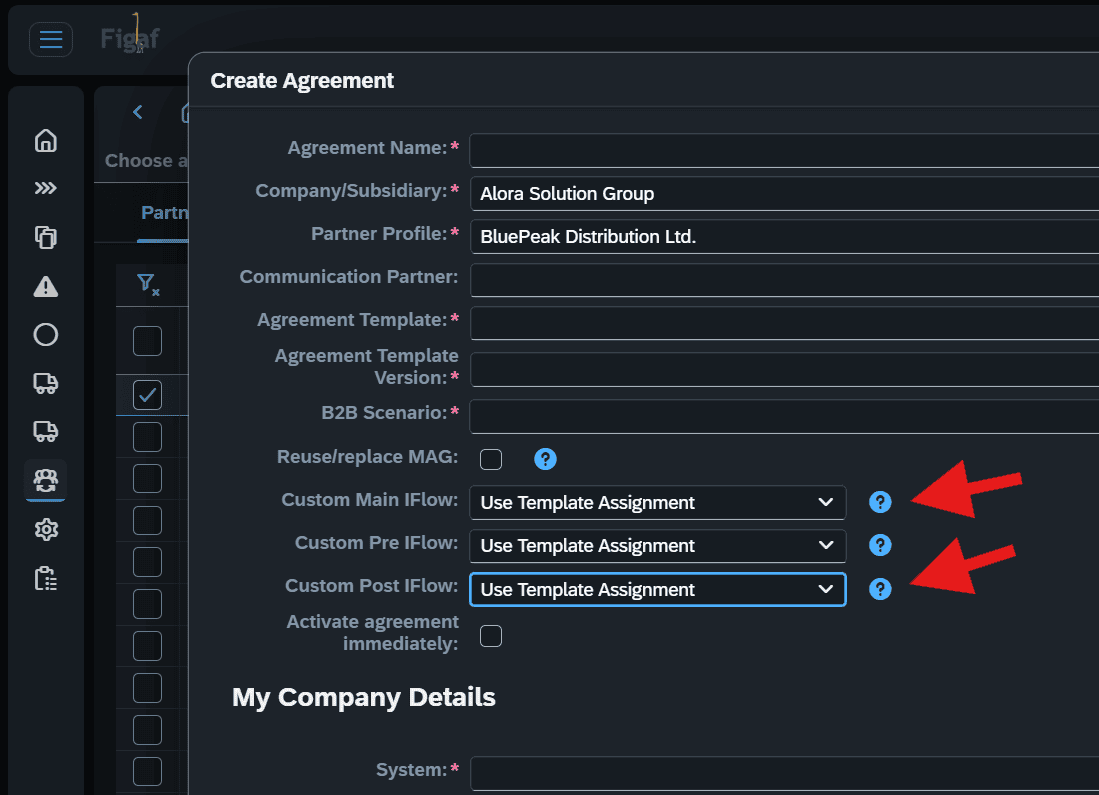
Generate agreements from the template. Instead of hand building the same fields for every partner, you create the agreement from the template on a single screen. Template selection is limited to templates created for the selected company or subsidiary, and Figaf checks that the type systems of the MIGs match the systems assigned before the agreement is created.
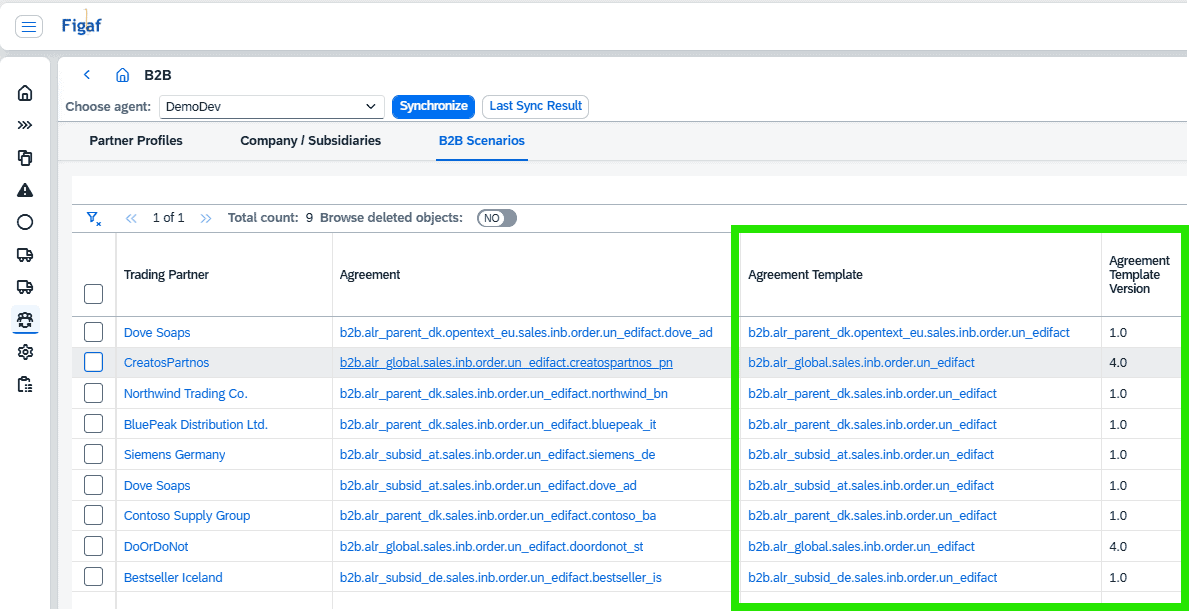
Deviations are visible. Where a template is not complete, for example when it does not cover all MAG versions or custom iFlows, you can pick an alternative MAG or an existing custom iFlow that uses the same source and target MIG combination. The B2B scenarios overview shows which agreement template and version each agreement uses, so deviations are not buried in a one off configuration.
Same result for new and migrated partners. Creating an agreement for new business and migrating an operation mapping from SAP PI/PO use the same process, with the agreement template for the specific company and partner.
Template versioning. SAP made versioning of agreement templates mandatory, with the option to keep a template in draft. Figaf supports this and shows the template version in the B2B scenarios overview.
Validation rules. A rules engine checks naming conventions, identifier schemes, and MIG and MAG version consistency against production, and flags what is off standard before transport.
Transport with dependencies. When you transport B2B scenarios, Figaf also considers the agreement template, which can contain more scenarios using other MIGs and MAGs, and makes sure those are in the target system too. By default drafts cannot be transported, but you can choose to allow drafts of agreement templates and agreements.
See which template and version every agreement usesCreate an agreement from the template on one screen
Business value
Lower maintenance cost. When most agreements follow the same template, a change is checked once instead of for every partner.
Faster onboarding. A new partner inherits an approved pattern instead of being configured from scratch, so the hundredth partner takes no more effort than the tenth.
Fewer errors. Validation and automatic checks catch a misconfigured partner before the first message fails.
Less dependency on specialists. The pattern lives in the template and the rules, not in the memory of the person who set up the last partner.
Audit ready. Templates and agreements are versioned and transported as tracked objects, with who, what and when.
Good to know
Agreement templates are part of Figaf B2B Management on SAP Integration Suite TPM.
The single screen agreement creation came in release 2603, agreement template versioning in release 2604, and transport of drafts for templates and agreements in release 2606.